Skip site announcements
Skip available courses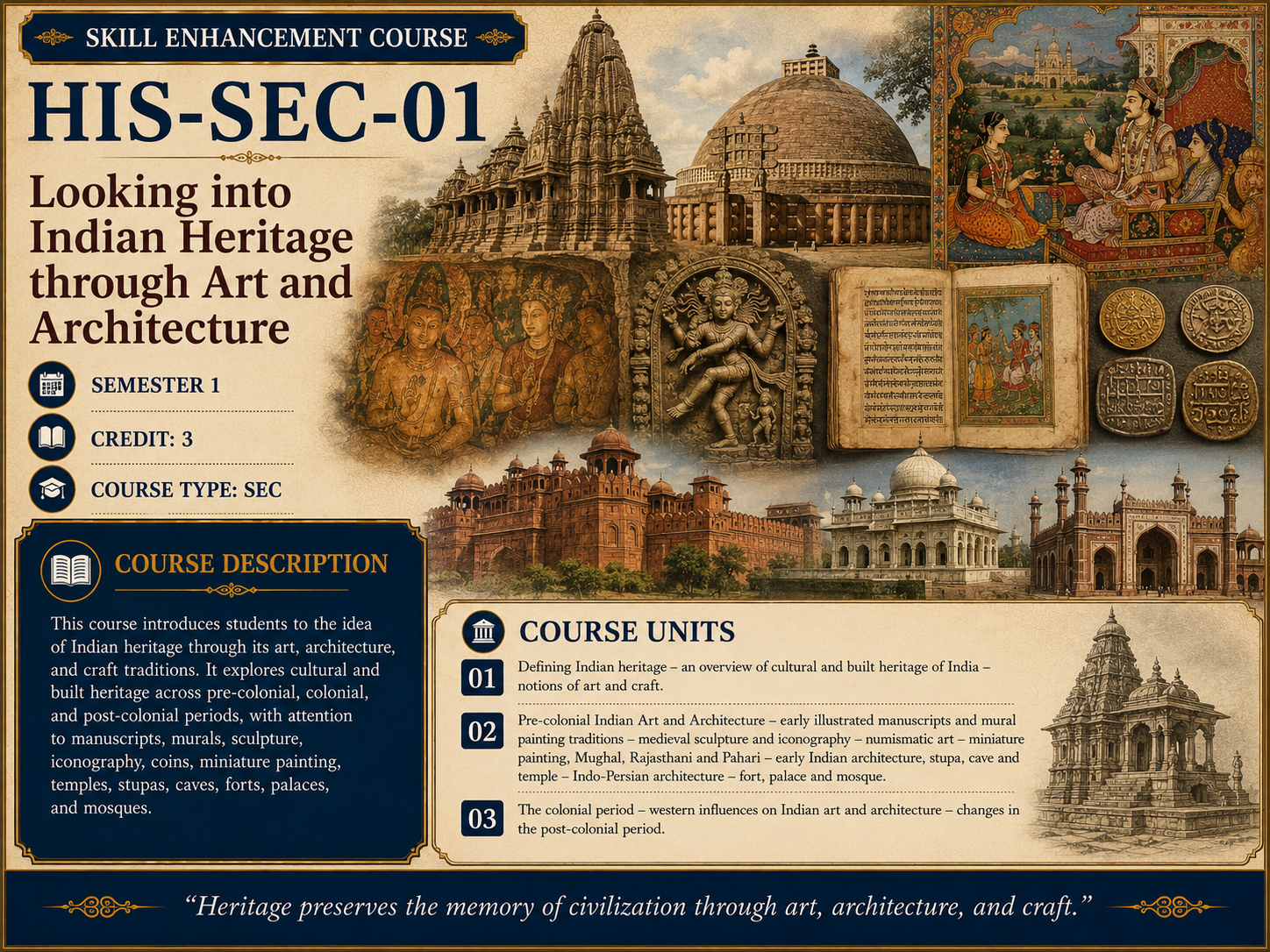
Skip course categories

Site announcements
There are no discussion topics yet in this forum.
Skip available courses
Available courses
Course Learning Outcomes
- Define Indian heritage and identify major categories of India's cultural and built heritage.
- Describe pre-colonial Indian art traditions, including manuscript illustration, mural and miniature painting.
- Identify and classify architectural forms such as stupas, cave and temple architecture and Indo-Persian monuments.
- Analyze the influence of Western art and architecture on Indian heritage during the colonial period.
- Evaluate changes and continuities in Indian art and architecture in the post-colonial period.
- Teacher: Subhajit Ghosh
- Teacher: Indrani History
- Teacher: Subhadip History
- Teacher: Subhendu History
- Teacher: Sumila History
- Teacher: Site Owner
- Teacher: Atriya Sarkar
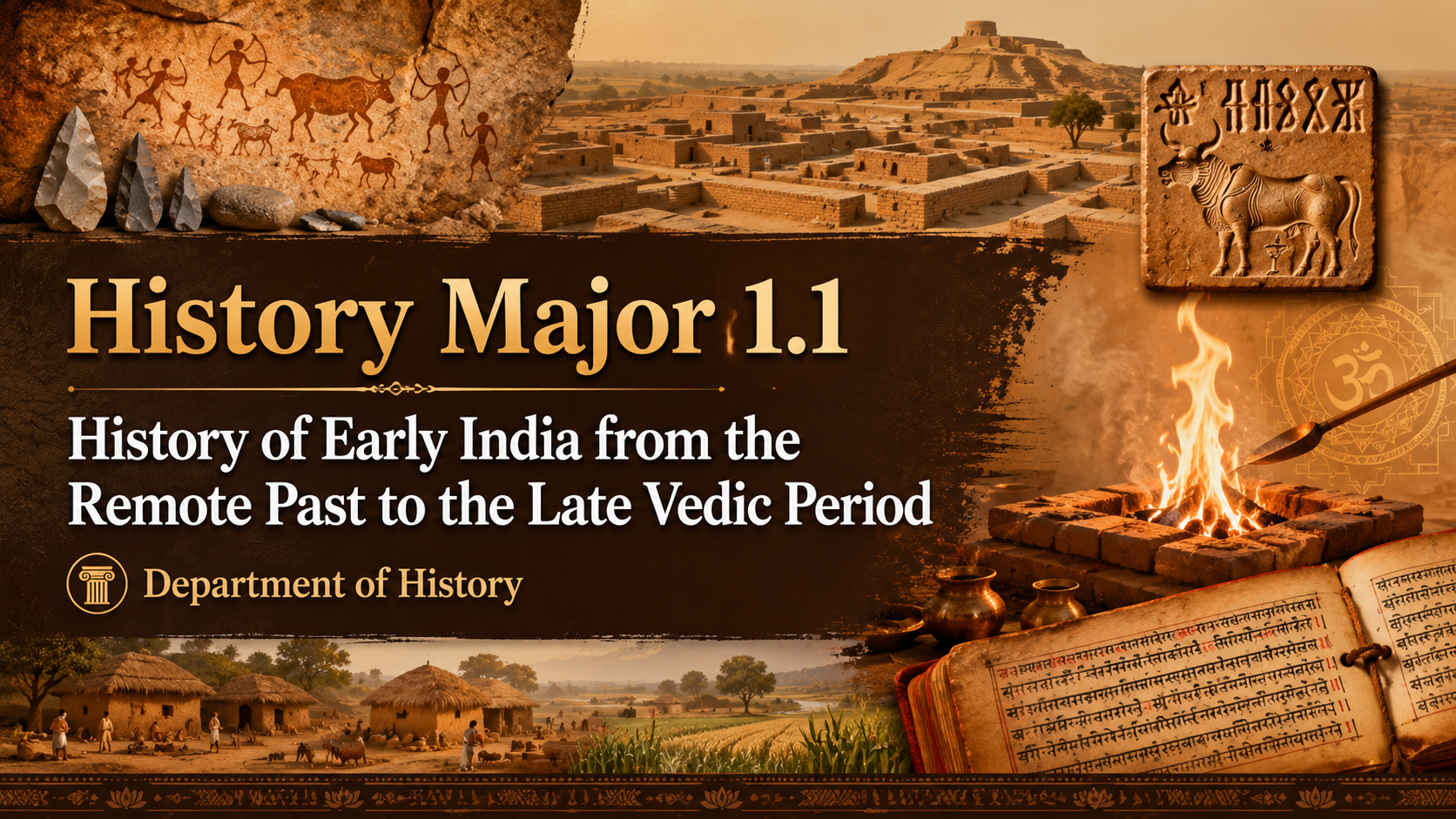
Course Learning Outcomes
- Recall the major phases of prehistoric and protohistoric cultures in India, from the Paleolithic to the Late Vedic period.
- Explain the salient features of the Harappan Civilization and the debates surrounding the Indus script and its decline.
- Compare imperialist, nationalist, leftist, liberal, secular and religious schools of historiography on early India.
- Analyze the emergence of caste society, organized religion and state territoriality in Vedic and post-Vedic India.
- Evaluate the socio-political and religious factors behind the rise of Magadha as an imperial power and the spread of Ajivikism, Jainism and Buddhism.
- Teacher: Site Owner
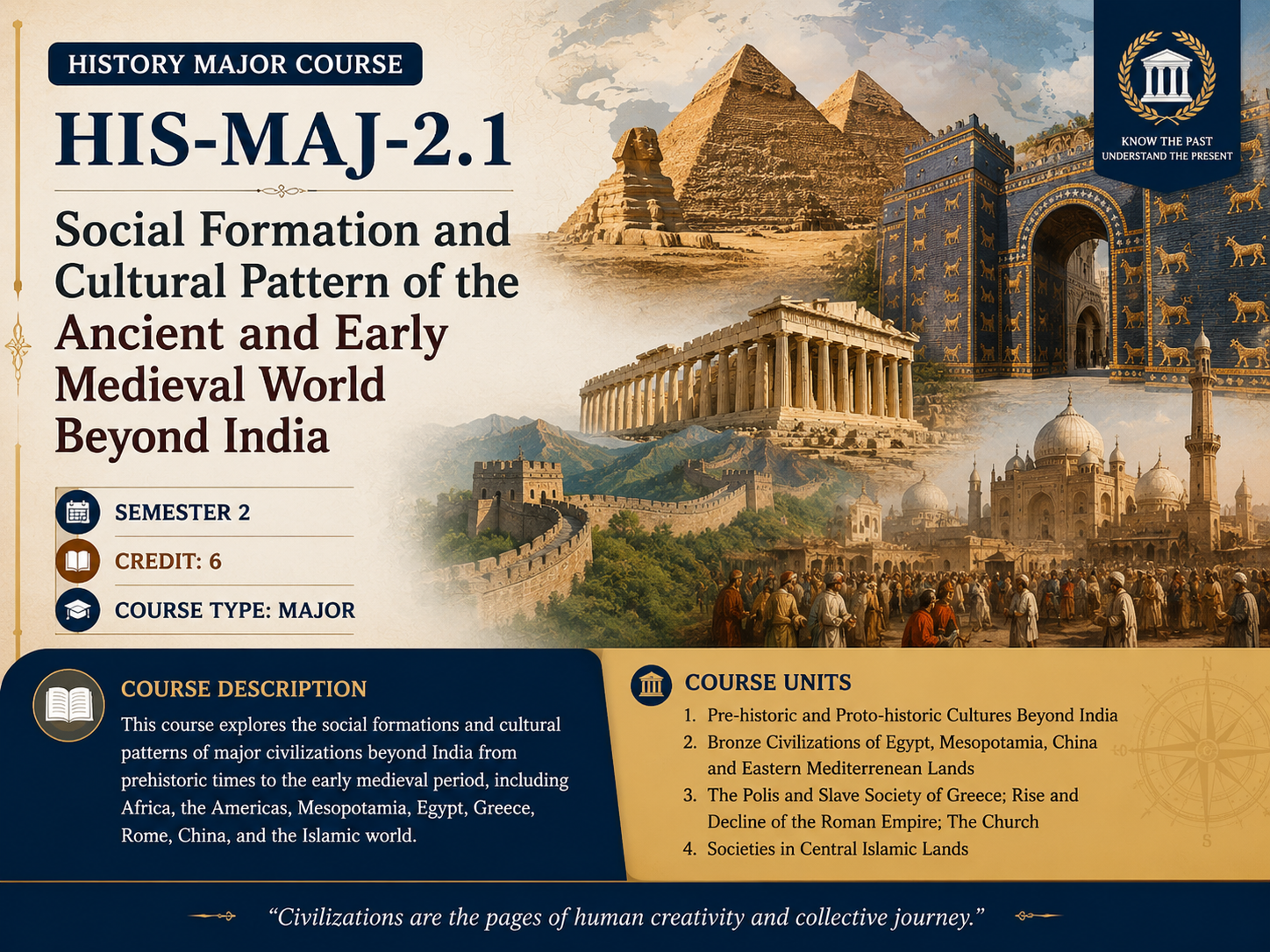
Course Learning Outcomes
- Identify the major prehistoric and Bronze Age civilizations of Africa, the Americas, Egypt, Mesopotamia, China and the Mediterranean world.
- Describe the social and political organization of the Greek polis and the institutions of Republican and Imperial Rome.
- Analyze the factors behind the decline of the Roman Empire and the rise of the Church as an organized religious institution.
- Explain the rise of Islam, the institution of the Caliphate, Shariah law and Sufi culture in Central Islamic lands.
- Compare patterns of state formation and cultural development across ancient and early medieval civilizations beyond India.
- Teacher: Site Owner
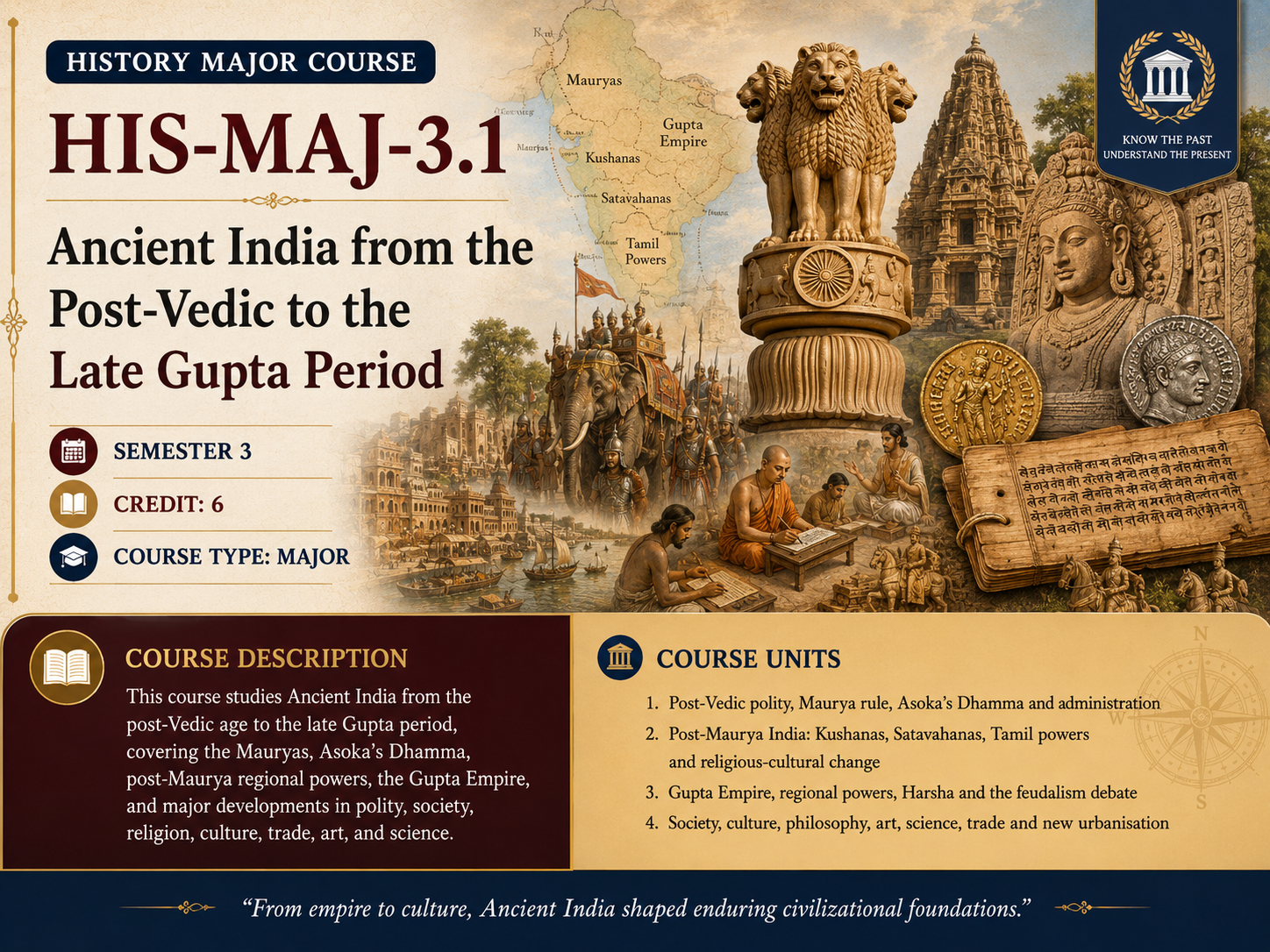
Course Learning Outcomes
- Recall the political history of the Mauryan, post-Mauryan and Gupta periods, including major dynasties and rulers.
- Explain Asoka's policy of Dhamma and its role in Mauryan administration and cultural conquest.
- Analyze changes in the caste system, spread of megalithic culture, and religious transformations (Jainism, Buddhism, Vaishnavism, Saivism, Tantricism) in post-Mauryan India.
- Evaluate the historiographical debate on the Gupta period as a 'Golden Age' and the debate on feudalism in Ancient India.
- Synthesize evidence on society, art, architecture, science, technology, trade and urbanization to characterize Early India in retrospect.
- Teacher: Site Owner
Course Learning Outcomes
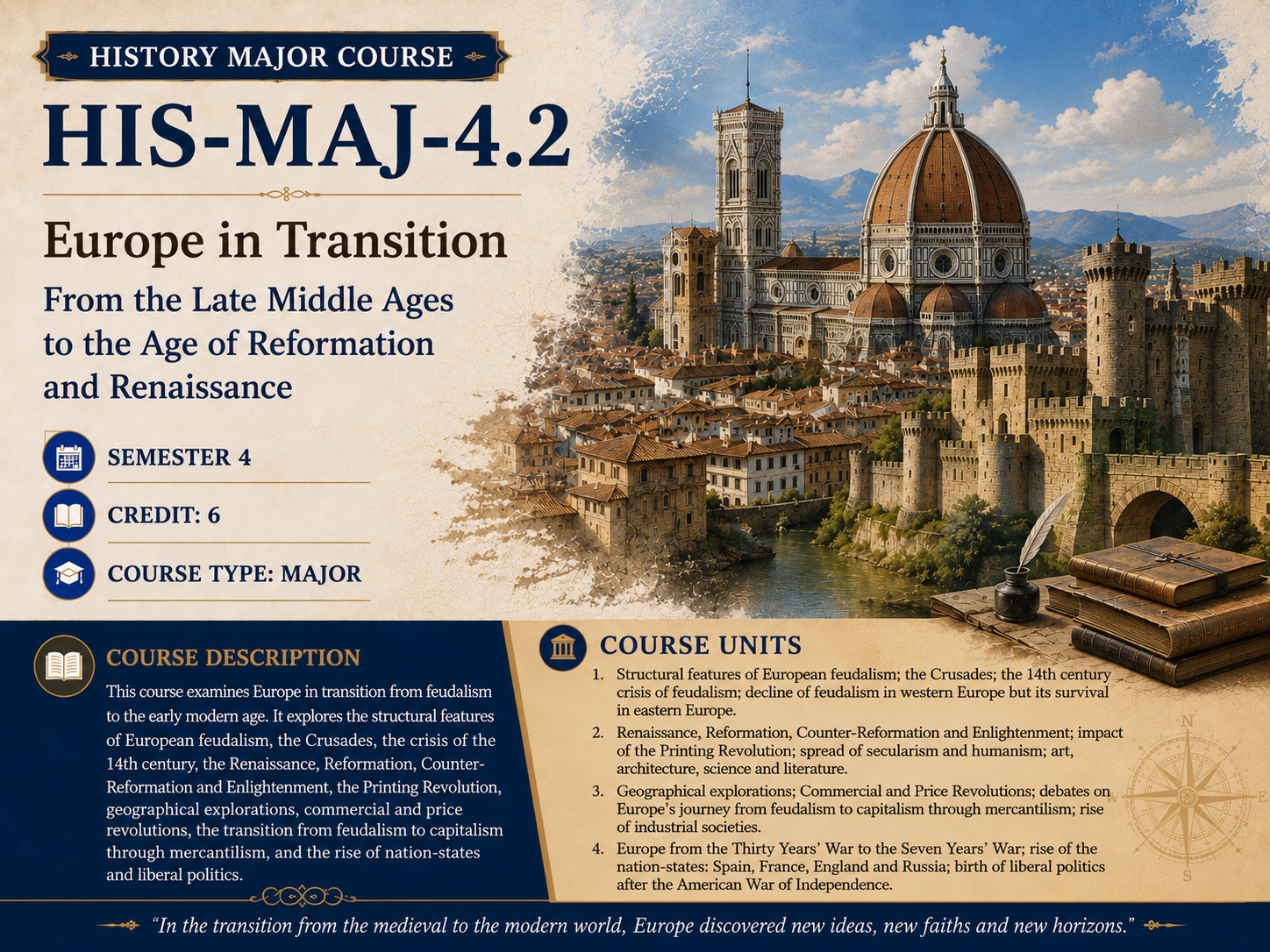
- Describe the structural features of European feudalism and the impact of the Crusades and the fourteenth-century crisis.
- Explain the Renaissance, Reformation, Counter-Reformation and Enlightenment as movements of intellectual and cultural transition.
- Analyze the debates on the transition from feudalism to capitalism in the context of geographical explorations and the Commercial and Price Revolutions.
- Trace the rise of the nation states of Spain, France, England and Russia between the Thirty Years' War and the Seven Years' War.
- Evaluate the significance of the American War of Independence in the birth of liberal politics in Europe.
- Teacher: Site Owner
Course Learning Outcomes
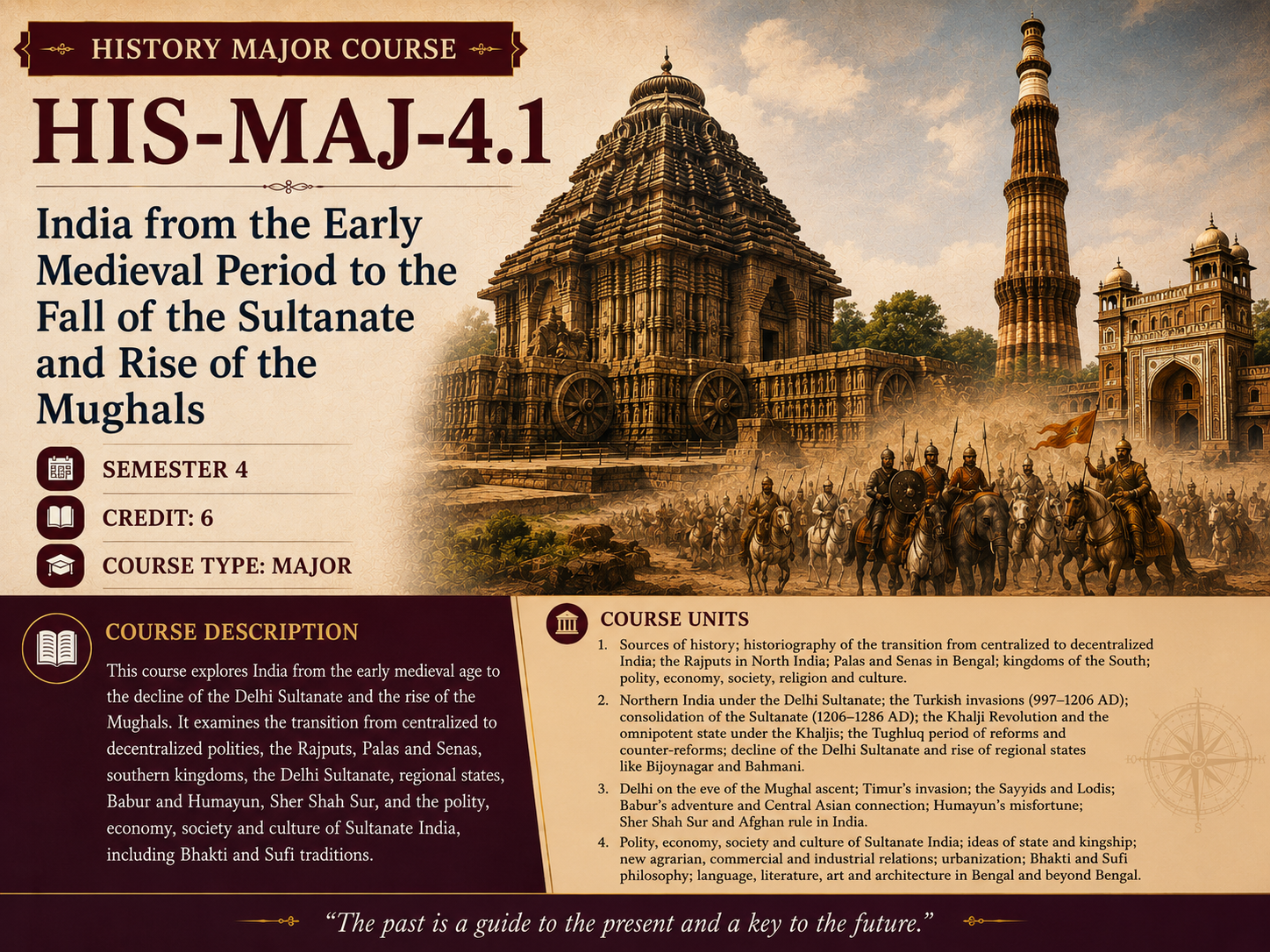
- Recall the chronology of political developments from the early medieval period through the Delhi Sultanate to the rise of the Mughals.
- Explain the historiographical debate on the transition from centralized to decentralized polity in early medieval India.
- Analyze the administrative reforms of the Khalji and Tughluq rulers and the causes of the decline of the Delhi Sultanate.
- Describe the socio-economic changes, urbanization, and the Bhakti-Sufi movements of Sultanate India.
- Assess the political and military factors that enabled Babur's establishment of Mughal rule in India.
- Teacher: Site Owner
Course Learning Outcomes
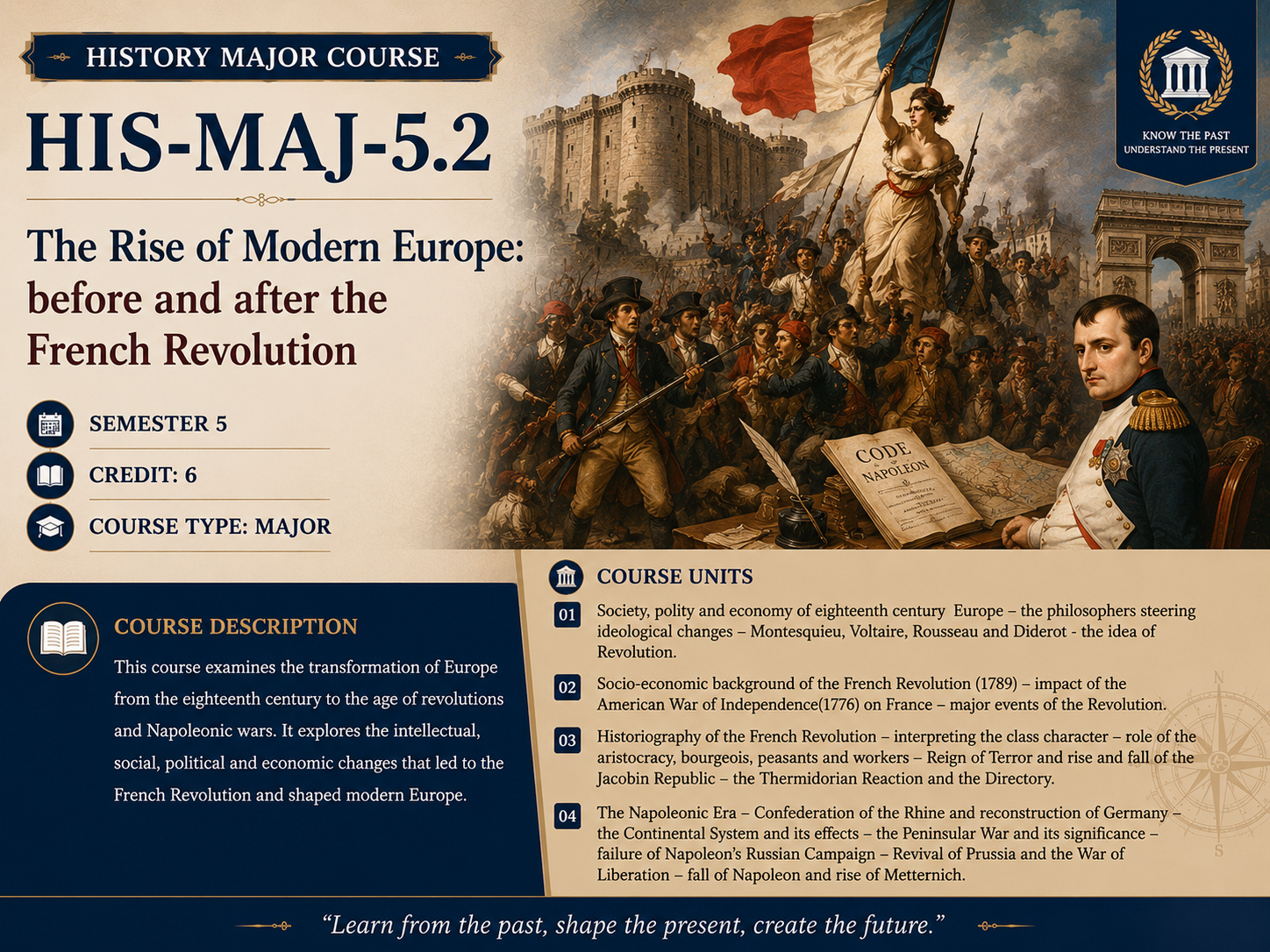
- Recall the major events and personalities of eighteenth-century Enlightenment thought and the French Revolution.
- Explain the socio-economic background of the French Revolution and the impact of the American War of Independence on France.
- Analyze competing historiographical interpretations of the class character of the French Revolution.
- Evaluate the course of the Revolution from the Reign of Terror to the Thermidorian Reaction and the Directory.
- Analyze the rise and fall of Napoleon and the impact of the Continental System on the political map of Europe.
- Teacher: Site Owner
Course Learning Outcomes
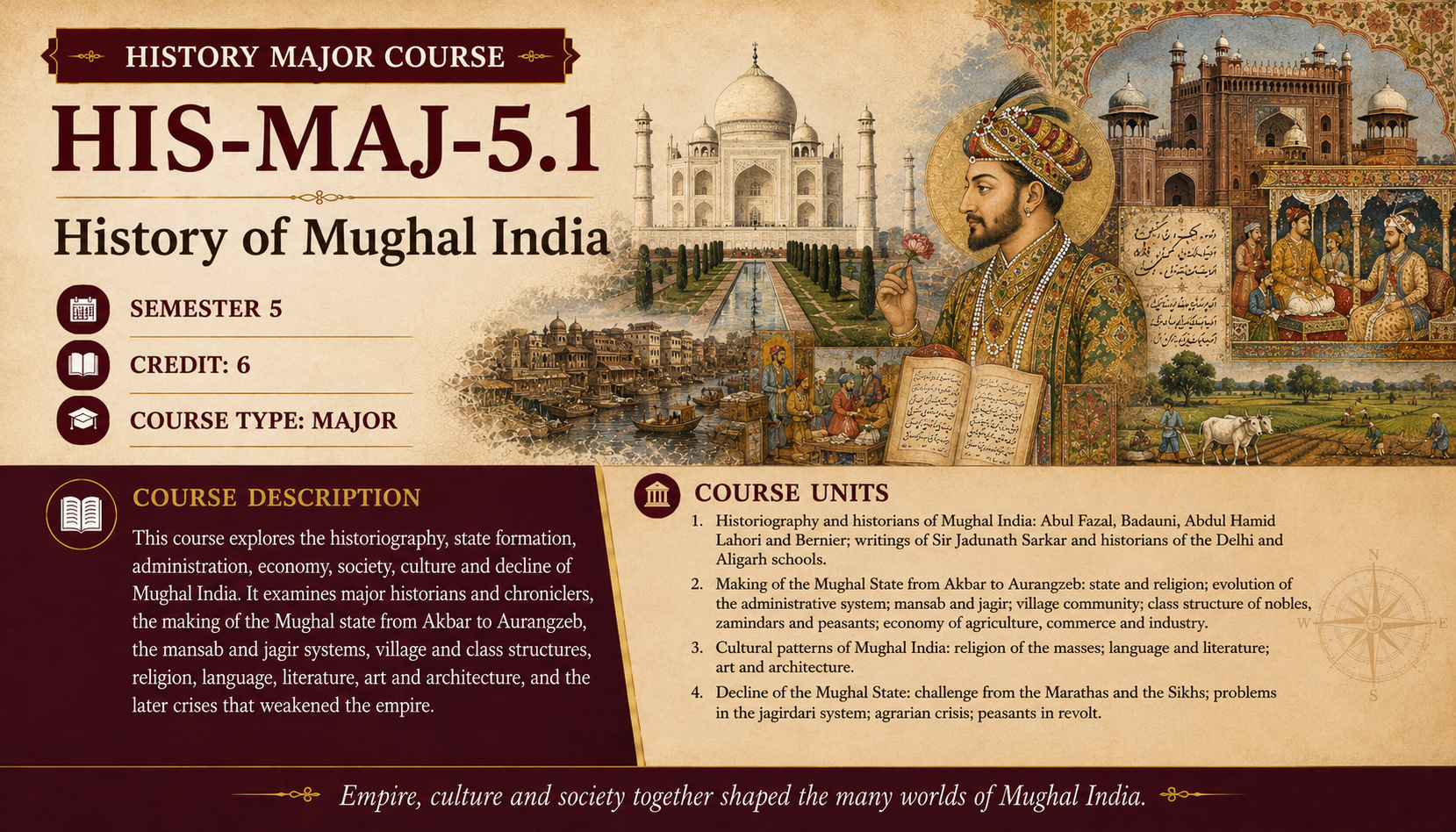
- Identify major chroniclers and historians of Mughal India and the Delhi and Aligarh schools of historiography.
- Explain the evolution of the Mughal administrative system, including the mansabdari and jagirdari institutions.
- Analyze the class structure of Mughal society comprising nobles, zamindars and peasants, and the agrarian and commercial economy.
- Describe the cultural patterns of Mughal India, including religion, language, art and architecture.
- Evaluate the causes of the decline of the Mughal state, including the jagirdari crisis, agrarian crisis, and challenges from the Marathas and Sikhs.
- Teacher: Site Owner
Course Learning Outcomes
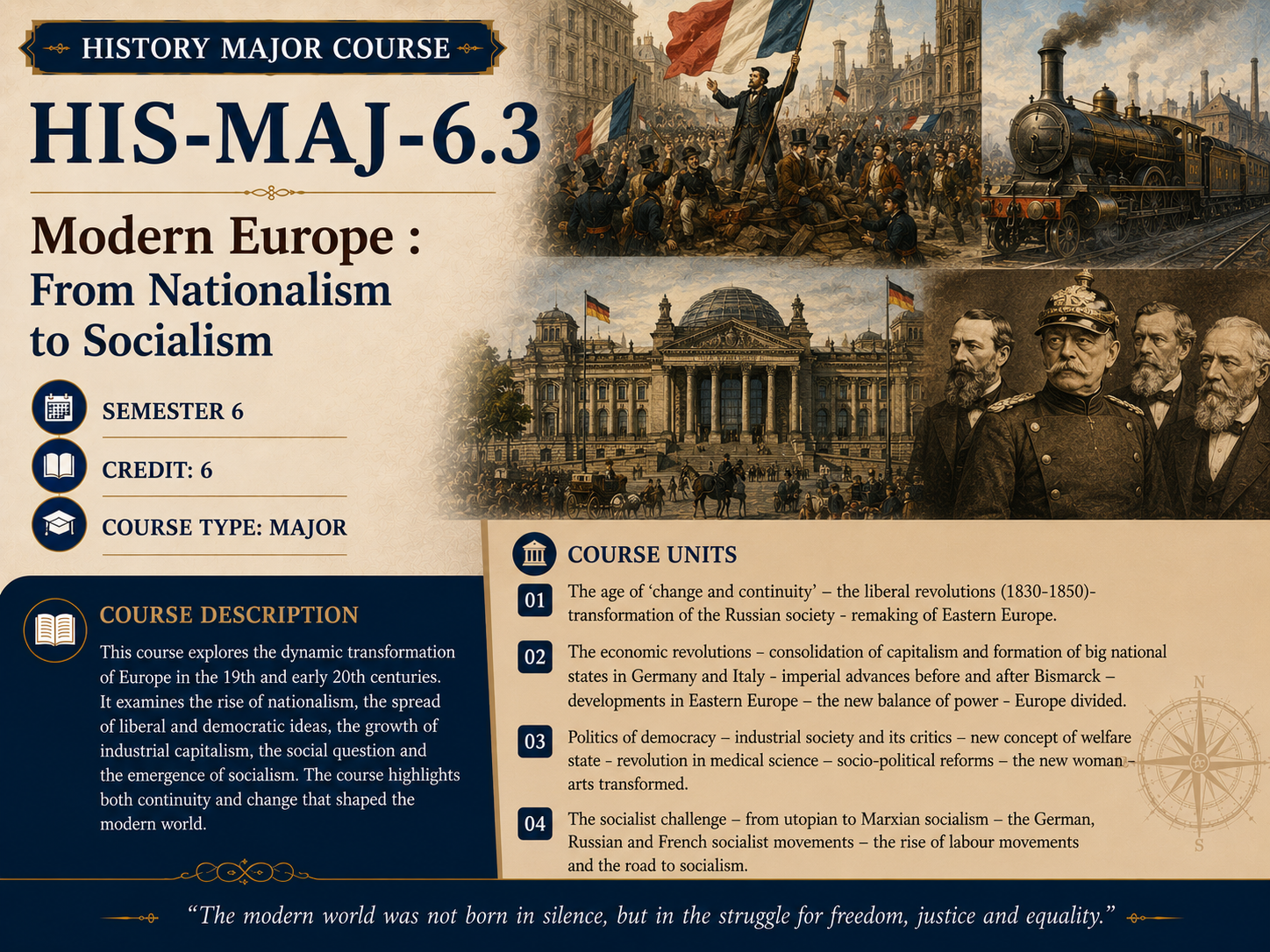
- Recall the major liberal revolutions of 1830-1850 and the process of German and Italian unification.
- Explain the economic transformations that consolidated capitalism and led to the formation of new national states in Europe.
- Analyze the diplomatic strategies of Bismarck and the resulting shifts in the European balance of power.
- Describe the rise of democratic politics, the welfare state, and changing gender roles ('the new woman') in industrial society.
- Evaluate the development of socialist thought from utopian socialism to Marxism across Germany, France and Russia.
- Teacher: Site Owner
Course Learning Outcomes
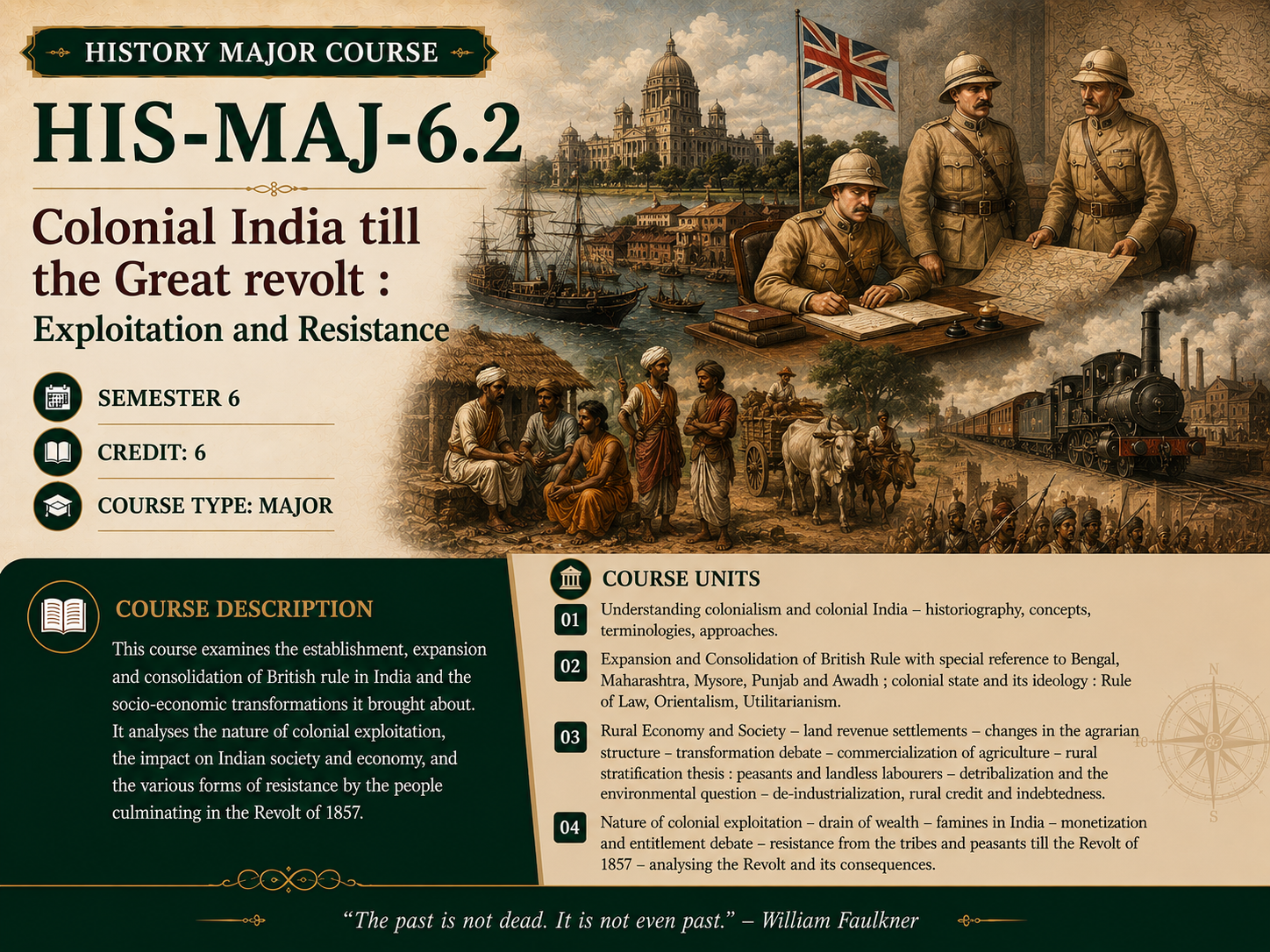
- Explain key concepts, terminologies and historiographical approaches to understanding colonialism in India.
- Describe the expansion and consolidation of British rule and the colonial ideologies of the Rule of Law, Orientalism and Utilitarianism.
- Analyze changes in the agrarian structure resulting from land revenue settlements, commercialization of agriculture, and de-industrialization.
- Evaluate the drain-of-wealth thesis and the causes and consequences of famines under colonial rule.
- Analyze the causes, course and consequences of the Revolt of 1857 as a form of resistance to colonial exploitation.
- Teacher: Site Owner
test summary via GET
Course Learning Outcomes
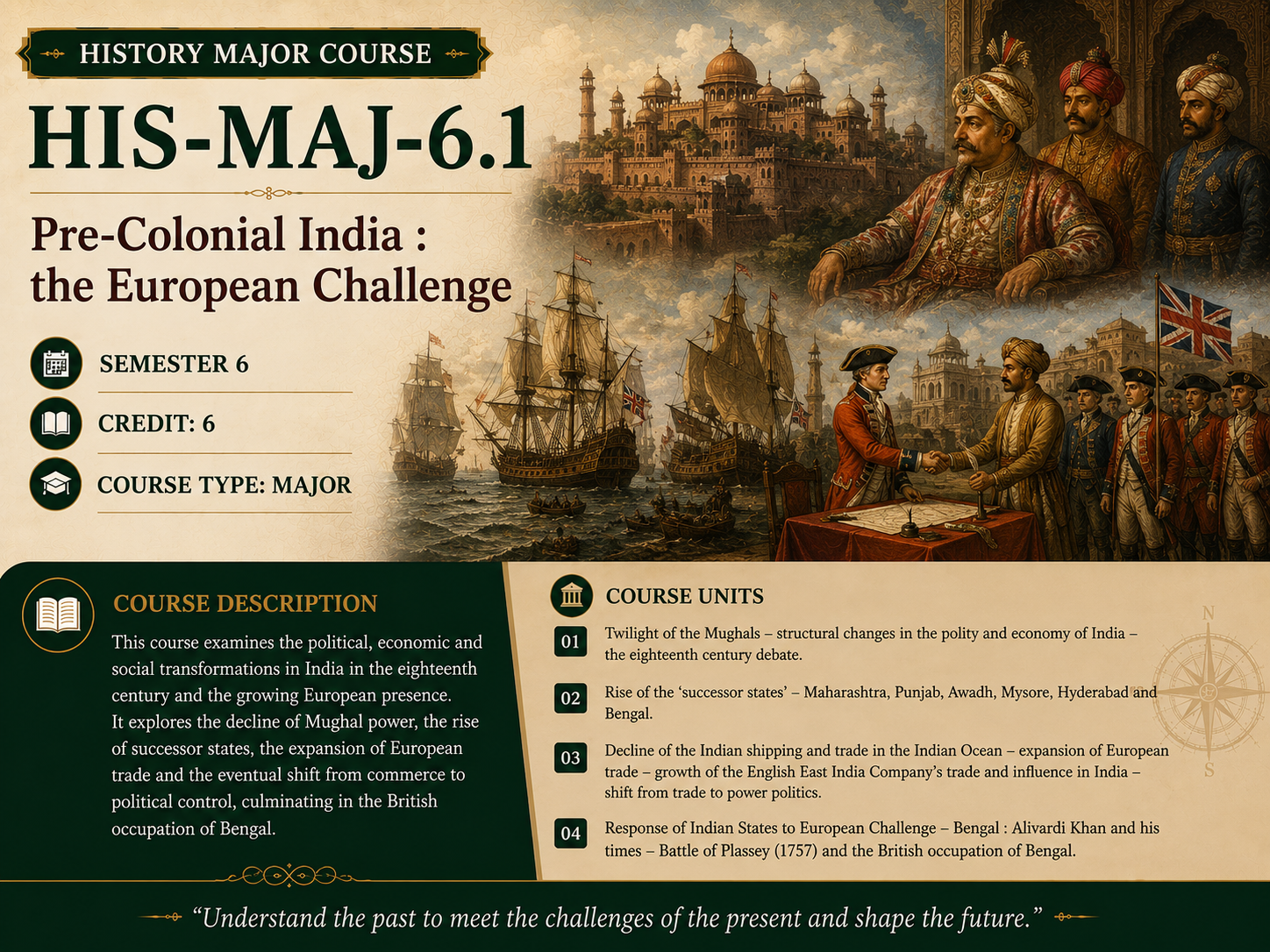
- Recall the rise of the eighteenth-century successor states of Maharashtra, Punjab, Awadh, Mysore, Hyderabad and Bengal.
- Explain the structural changes in eighteenth-century Indian polity and economy following the decline of Mughal authority.
- Analyze the decline of Indian shipping and trade in the Indian Ocean and the growth of the English East India Company's influence.
- Compare the shift from trade to power politics among European trading companies in eighteenth-century India.
- Evaluate Bengal's response under Alivardi Khan to the European challenge, leading to the Battle of Plassey and British occupation of Bengal.
- Teacher: Site Owner
Course Learning Outcomes
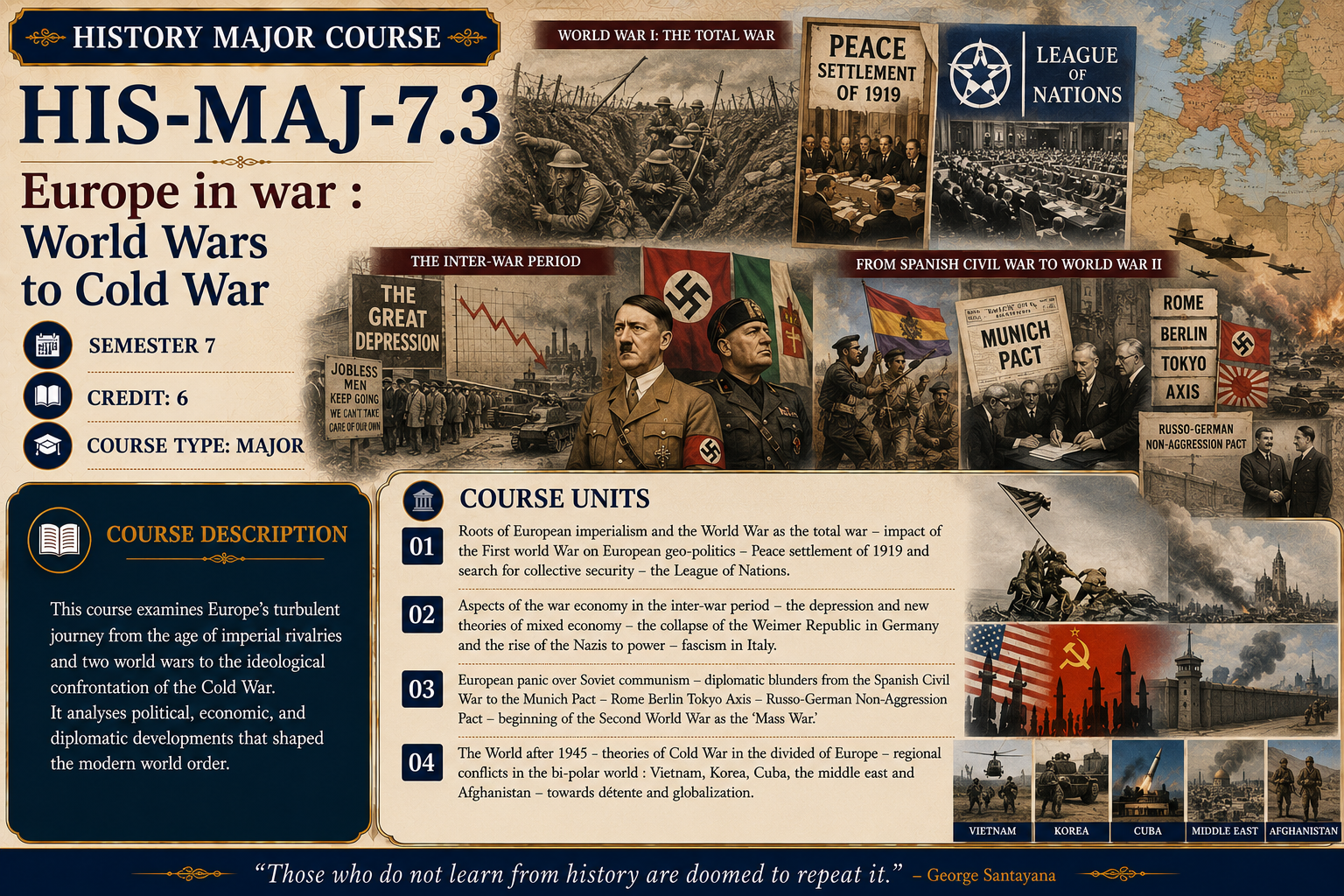
- Recall the sequence of events from the roots of European imperialism through the First and Second World Wars to the Cold War.
- Explain the impact of the war economy and the Great Depression on the collapse of the Weimar Republic and the rise of Nazism and Fascism.
- Analyze the diplomatic failures, from the Spanish Civil War to the Nazi-Soviet Pact, that precipitated the Second World War.
- Evaluate competing theories of the origins and course of the Cold War in a bipolar world.
- Analyze regional Cold War conflicts (Vietnam, Korea, Cuba, the Middle East, Afghanistan) and the movement towards détente and globalization.
- Teacher: Site Owner
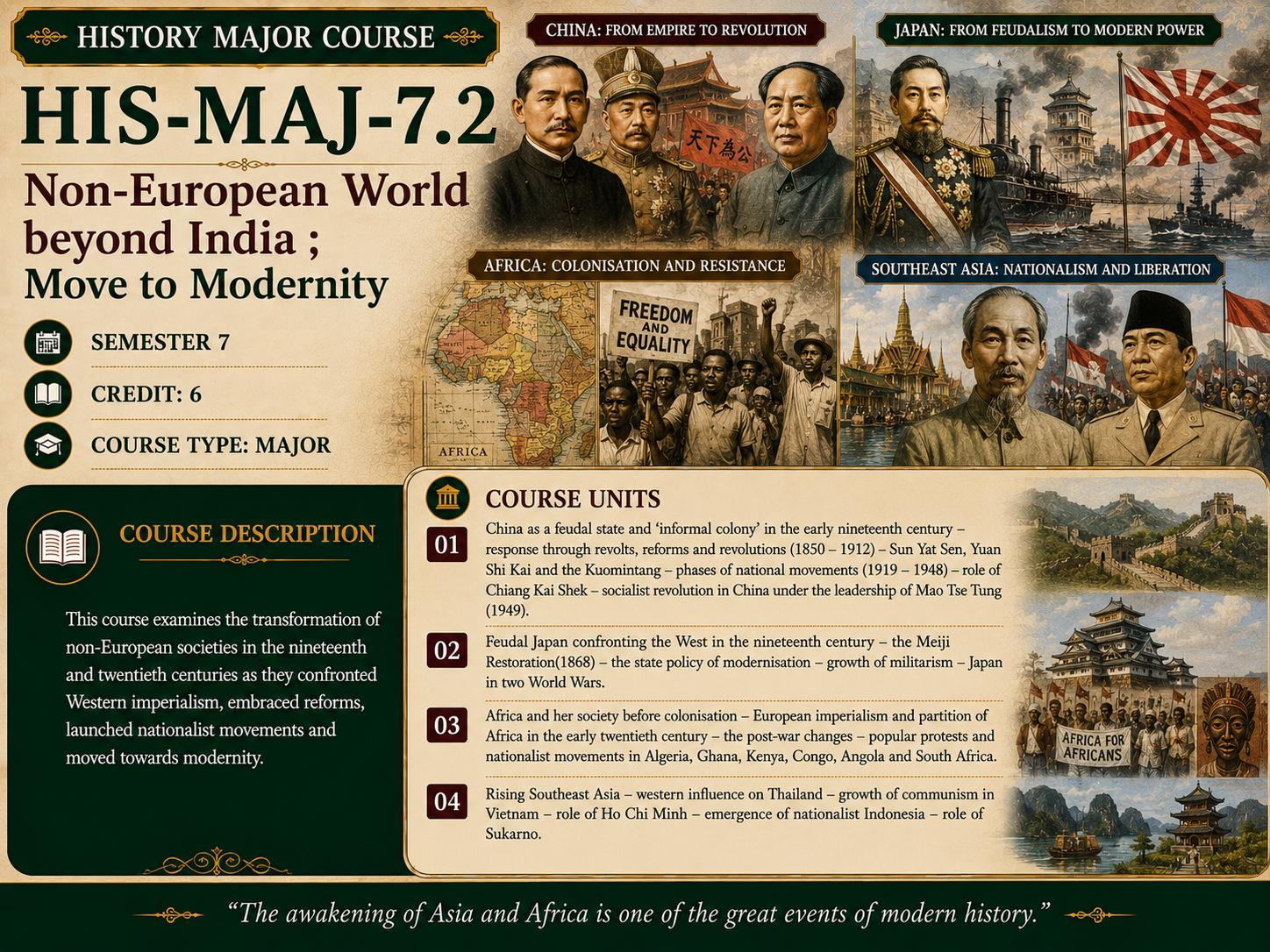
Course Learning Outcomes
- Recall the major phases of modernization and nationalist movements in China, Japan, Africa and Southeast Asia.
- Explain the Meiji Restoration as a state policy of modernization and its consequences for Japanese militarism.
- Analyze the process of European imperialism and partition of Africa and the emergence of post-war nationalist movements.
- Evaluate the roles of Sun Yat-sen, Chiang Kai-shek and Mao Tse-tung in China's transition from feudal state to socialist revolution.
- Compare the paths to modernity and independence taken by Vietnam, Indonesia and other Southeast Asian nations.
- Teacher: Site Owner
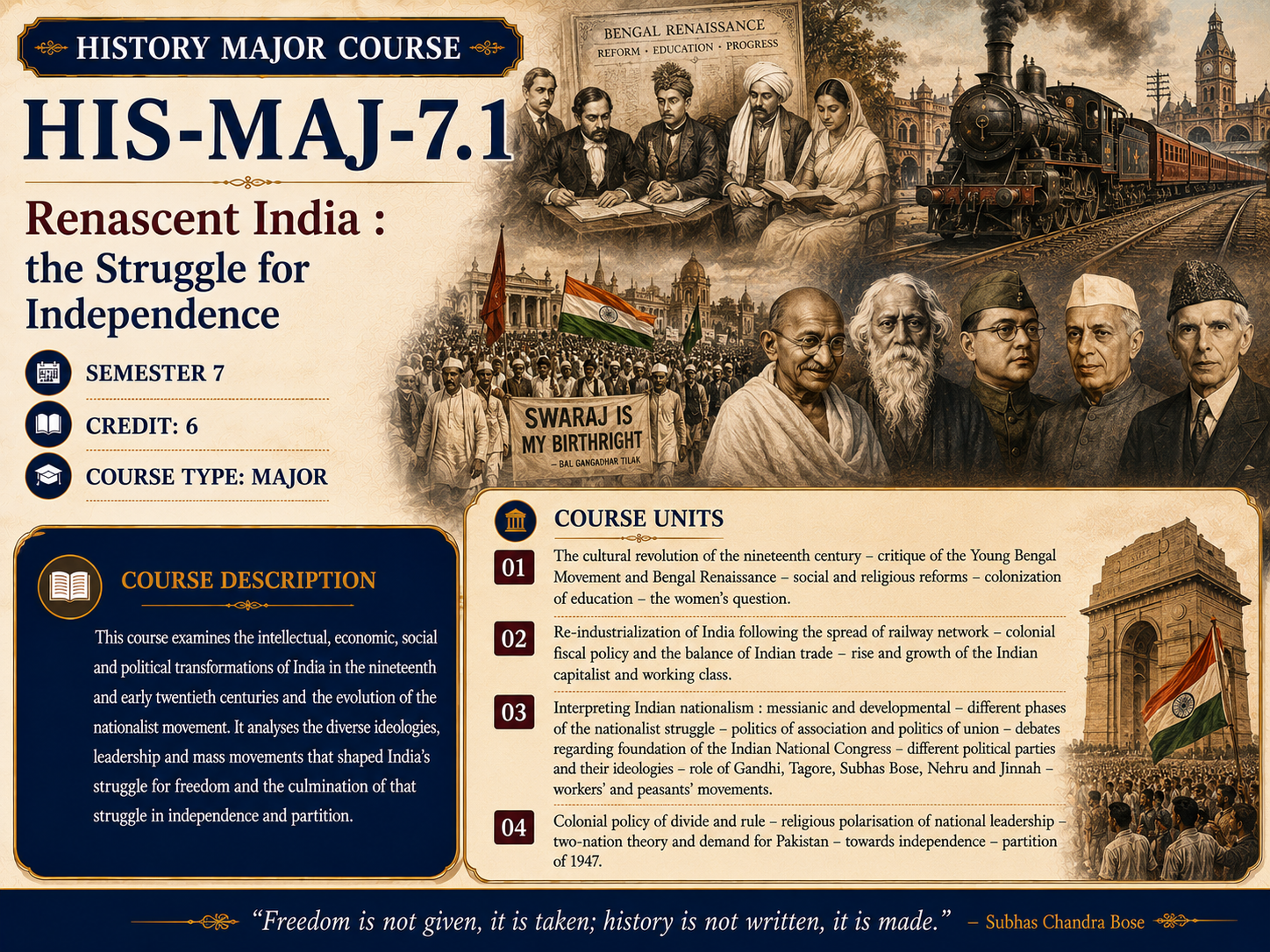
Course Learning Outcomes
- Recall the major events and leaders of the Indian national movement from nineteenth-century reform to Independence in 1947.
- Explain the cultural revolution of the nineteenth century, including the Bengal Renaissance, social-religious reforms and the women's question.
- Analyze the rise of the Indian capitalist and working classes in relation to colonial fiscal policy and railway expansion.
- Evaluate the differing ideologies and strategies of Gandhi, Tagore, Subhas Bose, Nehru and Jinnah within the freedom struggle.
- Analyze the colonial policy of divide and rule, the two-nation theory, and the events leading to the Partition of 1947.
- Teacher: Site Owner
Skip course categories